
Table of Contents
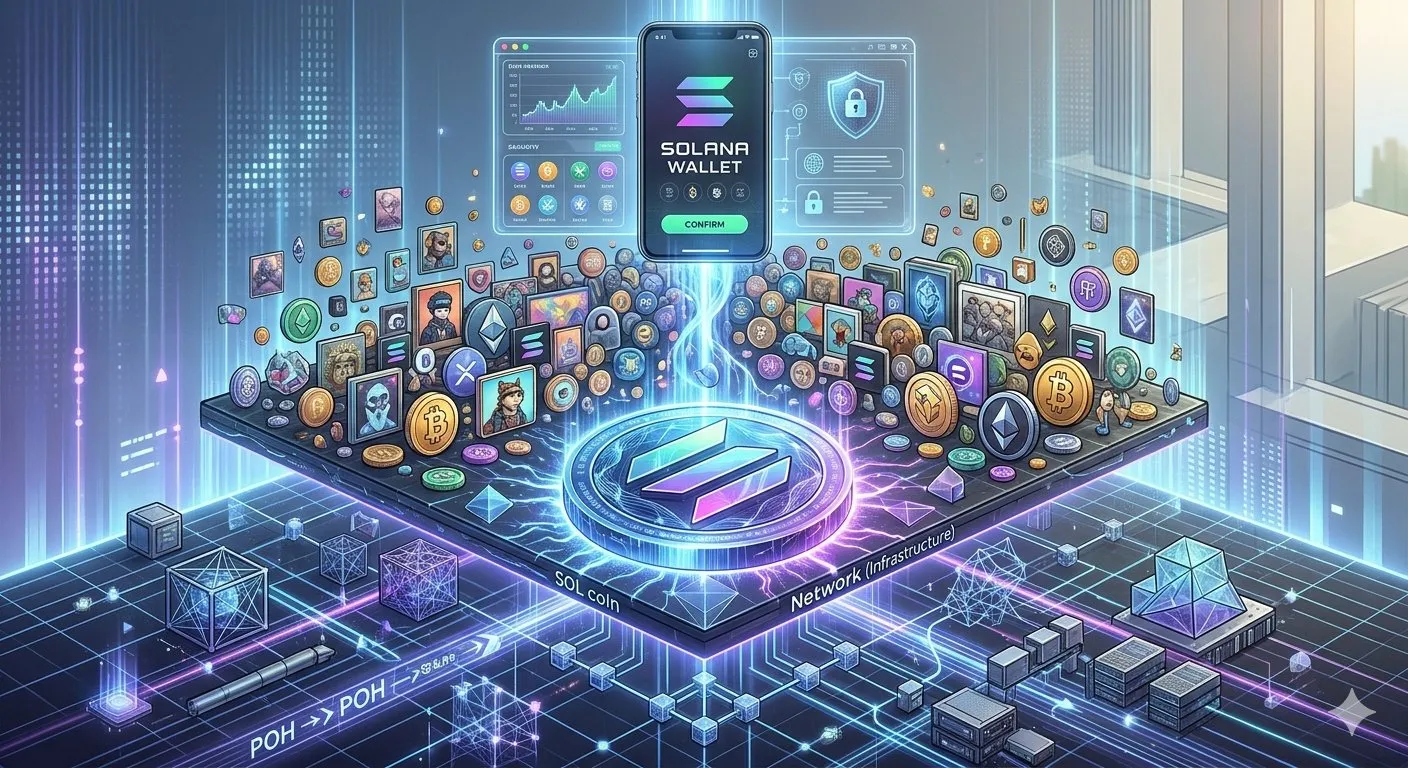
Newcomers often use one word, Solana, to mean four different things. The network, its native coin, the tokens built on it and the wallet in your pocket are separate pieces with separate jobs. Mixing them up is the single biggest source of beginner confusion.
Pulling them apart is the quickest route to understanding the whole system. We will take them one layer at a time, from the bottom up.
The Network Layer
Solana explained at its simplest: a public blockchain where thousands of computers keep a shared record of balances and programs. People use it to send value, trade assets and run applications. Each layer depends on the one below it, so the order matters.
Like other blockchains, it has no owner you can phone. Its rules are open, and its record can be inspected by anyone. It is best thought of as shared infrastructure, a bit like a road system rather than a shop. Applications on top simply make use of that shared record.
SOL, the Native Coin
SOL is the coin native to the network. Its main everyday job is paying for activity, because transactions on Solana require a small fee denominated in SOL. Without a little SOL, even moving other assets can stall. Think of the amount you need as small but never optional.
That is why beginners should keep a small balance for fees before doing anything else. Treat it as fuel, not as the whole story. The coin is part of the network, but it is not the network itself. Always check your balance before attempting a transaction.
Tokens Built on Top
Many other assets live on the same network, from stablecoins to community tokens. They share the chain but are independent from SOL, with their own issuers, supply and risks. Sharing infrastructure does not mean sharing quality. Each token carries its own risks, and some carry a great deal.
Names can be copied, so a token’s real identity comes from its unique address. Before interacting with any token, confirm that address against an official source. A lookalike with the same name and logo is a classic trap. Checking takes under a minute and can save you everything.
How Solana Differs From Bitcoin
Both are blockchains, yet they were designed for different purposes. Bitcoin focuses on being a durable, simple record of value transfers. Solana aims to run many kinds of applications quickly, with transactions that cost little. Neither design is automatically better; each suits different goals.
Their tools differ as well. Wallets, addresses and fee systems are not interchangeable, so sending an asset to the wrong kind of address can cost you the funds. Always confirm which network you are using before you send.
Your Wallet, the Control Panel
A wallet is software or hardware that holds the keys proving you control your assets. It shows balances and signs transactions, yet the assets themselves remain recorded on the network. Lose the keys and you lose access. Hardware wallets add an extra layer by keeping keys on a separate device.
Your recovery phrase is the master backup, so keep it offline and never share it. Be cautious whenever a site asks you to connect or sign something you do not understand. Read the request first, then decide. A moment of hesitation here is usually a sign of good instincts.
Fees and Confirmations
Every action on the network, such as sending SOL or swapping a token, is a transaction with a fee. On Solana these fees are usually small, which suits frequent, low-value activity. Small is not zero, though, and conditions can change. Wait for confirmation before assuming a payment has landed.
After you approve a transaction, the network confirms it and updates the shared record. You can then look it up in a block explorer to see what happened. Checking that receipt is a habit worth building early. Over time the explorer becomes the easiest way to understand what your wallet just did.
Keep the Layers Straight
Once you separate the network, the coin, the tokens and the wallet, most Solana questions become easier to answer. Confusion usually appears when two layers get blended into one.
For a visual walkthrough of how these parts fit together, visit StonkBuilder Learn, where the topic is broken into short, beginner-friendly lessons. Review the layers there, then revisit this article and see how much now feels familiar.
